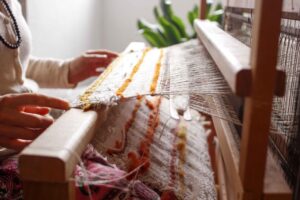

Beginner weaving kits vary widely, and not every included accessory is necessary for a first project. The useful starting point is a small set of tools that helps you control tension, pass the weft through the warp, and finish your work neatly.
Weaving can look gear-heavy from the outside, but beginners do not need a studio full of equipment. A suitable loom, strong warp yarn, a shuttle or tapestry needle, a beater, and a few basic supplies are enough for many introductory projects.
This guide focuses on the weaving tools that matter most when you are starting out. You will learn what each tool does, when it is worth buying, and what can wait until you have chosen the types of projects you want to make.
Think of it as a practical starter list—not a shopping spree.
Essential Beginner Weaving Tools: What Each Tool Does and Why You Need It
A beginner weaving setup does not need to be expensive, but choosing tools that suit the intended project can make setup and tension control easier. When comparing kits, pay attention to the loom type and the tools included rather than the number of accessories in the box.
- Loom: A frame loom holds the warp under tension and works well for tapestry-style wall hangings, samples, coasters, and other small pieces. A rigid heddle loom, such as the Schacht Cricket or Ashford SampleIt, has an integrated heddle and beater and is suited to scarves, table runners, and lengths of cloth.
- Shuttle: A shuttle carries weft yarn across the warp. A stick shuttle is simple, affordable, and sufficient for many frame-loom and rigid-heddle projects.
- Tapestry needle: A blunt tapestry needle is useful for weaving small shapes, changing colors, working in tight areas, and finishing loose ends. Choose an eye large enough for the yarn without forcing it through.
- Warping equipment: A separate warping board is not normally needed for a basic frame loom. Many rigid heddle looms include a warping peg for direct warping. A warping board becomes useful when you move to indirect warping or need to measure a more complex warp.
On a frame loom, a shed stick can hold one shed open and reduce repetitive over-and-under picking. You will also want a weaving comb or fork for packing the weft, sharp scissors, and a tape measure. On a rigid heddle loom, the heddle usually creates the shed, spaces the warp, and beats the weft, so a separate shed stick and comb may not be necessary for plain weave.
For a small cotton wall hanging, a frame loom, stick shuttle or tapestry needle, weaving comb, strong cotton warp, and suitable weft yarn are enough to begin. Prioritize a loom that holds tension securely and a smooth, low-stretch warp yarn before buying decorative accessories.
How to Build a Practical Starter Weaving Kit Without Wasting Money
Build your starter kit around the loom and project rather than buying a large general-purpose bundle. For a frame loom, begin with a tapestry needle or stick shuttle, a shed stick, scissors, a comb or weaving fork, strong warp thread, and one or two weft yarns. This setup works for wall hangings, coasters, bookmarks, and small fabric samples.
If your goal is to make scarves, runners, or longer pieces of cloth, a compact rigid heddle loom may be a more suitable starting point than a frame loom. Check the package contents before ordering accessories: many rigid heddle looms already include stick shuttles, a threading hook, clamps, a warping peg, and a reed.
- Loom choice: A basic Beka-style frame loom suits small tapestry projects, while compact rigid heddle models such as the Ashford SampleIt or Schacht Cricket are designed for woven cloth.
- Warp yarn: Smooth, strong, low-stretch cotton is a common beginner choice because it can withstand tension and repeated contact with the shuttle or needle.
- Needles and beaters: Choose a blunt needle that fits the yarn and a comb or fork that fits comfortably between the warp threads. Metal, wood, and durable plastic tools can all work when appropriately sized.
If possible, handle yarn before buying so you can compare its texture, stretch, and thickness. Local yarn and craft stores can help with this, while specialist weaving suppliers may offer a wider range of reeds, warp yarns, and replacement parts. Avoid oversized bundles until you know which loom type, yarn weights, and project styles you prefer.
Common Beginner Weaving Tool Mistakes That Make Learning Harder
A common mismatch is buying a large floor loom before deciding whether the goal is tapestry weaving, rigid heddle weaving, or multi-shaft cloth. A smaller frame or rigid heddle loom requires less space and is sufficient for learning basic concepts such as warp tension, beating, selvedges, and yarn behavior.
Another problem is choosing a kit with weak warp thread, excessively fuzzy yarn, or missing setup tools. Repeated warp breakage can result from unsuitable yarn, too much tension, abrasion against a rough loom part, or a combination of these issues. A shed that will not open cleanly may indicate uneven tension or a threading error rather than a lack of skill.
- Buying unnecessary warping equipment: A frame loom generally does not require a warping board, and a rigid heddle loom may include the peg needed for direct warping. Add other warping tools when a specific method or project calls for them.
- Using the wrong shuttle: A stick shuttle works well for many beginner projects. Boat shuttles are optional and work best when the loom provides enough shed depth and support; they are not an automatic upgrade for every loom.
- Ignoring yarn weight and sett: The yarn must suit the spacing of the warp, known as the sett. Very thick yarn on a fine sett can crowd the warp, while yarn that is too thin for a wide sett may produce fabric that is more open than intended.
It is tempting to buy every accessory advertised in courses or craft stores, but beginners rarely need all of them immediately. Start with a suitable loom, strong warp yarn, a tapestry needle or shuttle, scissors, and measuring tools. Add specialized equipment only when you understand the task it performs, such as simplifying warping, increasing weaving speed, or improving a particular finishing technique.
Key Takeaways: Choosing Beginner Weaving Tools
The most useful beginner weaving tools are the ones that match the loom and the first project. Choose a simple loom, reliable warp yarn, and a small set of appropriately sized tools. A frame loom is a practical choice for tapestry-style pieces, while a rigid heddle loom is better suited to scarves, runners, and longer cloth.
Before buying an accessory, ask whether it solves a problem in your current project and whether a similar tool is already included with the loom. Start with the essentials, then expand your toolkit as you learn which techniques and projects you want to pursue.
The WeaversRock Crafts Editorial Team researches, prepares, and reviews practical content about weaving, handmade crafts, creative home décor, beginner-friendly projects, and small craft businesses.
Our goal is to provide clear instructions, realistic ideas, useful comparisons, and responsible safety guidance for readers who enjoy creating by hand. Articles are reviewed for clarity, relevance, consistency, and obvious factual issues before publication.
We do not claim professional qualifications, personal testing, or first-hand experience unless those claims can be supported. Readers should always follow manufacturer instructions, use suitable tools, and take appropriate safety precautions when completing a project.