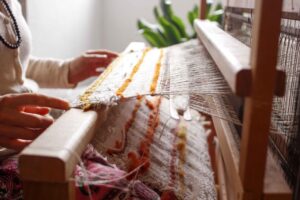

Why does a simple weaving project go wrong so quickly?
For beginners, most mistakes don’t come from a lack of creativity—they come from small habits that quietly affect tension, edges, pattern accuracy, and finishing.
A loose warp, uneven beat, skipped thread, or rushed selvedge can turn a promising piece into something frustrating before you realize what happened.
This guide breaks down the most common weaving mistakes beginners make, so you can avoid them early and build cleaner, stronger, and more consistent woven work.
What Beginner Weavers Often Misunderstand About Warp Tension, Yarn Choice, and Loom Setup
Many beginner weaving problems start before the first pick is woven. Warp tension should be firm and even, not drum-tight; over-tightening can snap threads, distort selvedges, and make the shed harder to open on a rigid heddle loom or floor loom.
A practical check is to press gently across several sections of the warp. The threads should feel broadly consistent. If some ends are noticeably slack while others are very tight, stop and adjust them before weaving. Uneven winding on the back beam is a common cause, especially when the warp layers are not separated with packing paper or warp sticks.
- Warp tension: Wind slowly under consistent tension, use suitable warp separators, and advance the warp before weaving too close to the heddle or reed.
- Yarn choice: Avoid using soft, stretchy knitting yarn as warp unless it is strong enough to withstand repeated tension and abrasion.
- Loom setup: Check threading, reed or heddle spacing, and tie-on knots before weaving the full project.
Yarn choice also affects cost, durability, and the finished fabric. Cotton carpet warp, mercerized cotton, linen blends, and wool weaving yarn behave differently, so an inexpensive yarn may be a poor value if it repeatedly breaks or produces unstable cloth.
On a small rigid-heddle loom such as the Schacht Cricket Loom, a wool yarn may work well as weft but still be too stretchy, fragile, or loosely spun for the warp. Match the yarn to the project, sample when possible, and treat loom setup as part of the weaving process—not a step to rush.
How to Prevent Uneven Edges, Loose Weft, Skipped Threads, and Other Early Weaving Errors
Many beginner weaving mistakes come from tension problems, not a lack of ability. Uneven edges often develop when the weft is pulled too tightly across the warp. Place the weft at a slight diagonal or in a gentle arc before beating it into place, and avoid tugging it tight at the selvedge. This allows room for weft take-up and helps reduce draw-in.
Loose or uneven weft can appear when the beat changes, especially when switching between cotton, wool, or textured yarns. Weave a small sample before starting a scarf, wall hanging, or table runner. Record the yarn, heddle or reed spacing, project width, and approximate beat so you can repeat the setup. Use a ruler to check the width regularly rather than waiting until several inches have been woven.
- Check warp tension before weaving; it should feel firm and reasonably even, not guitar-string tight.
- Use a shuttle that suits the loom width so the weft passes smoothly without snagging.
- Look for skipped threads or unintended floats every two or three rows instead of discovering them after several inches.
If threads keep skipping, inspect the heddle slots, reed, and warp path for crossed yarns, incorrect threading, or yarn that is sticking together. Correctly sized tools and clear loom instructions can reduce frustration and wasted material. Slow down at the edges and fix small errors early so they do not continue through the fabric.
Troubleshooting Weaving Mistakes: When to Adjust, Unweave, or Keep Going
Not every weaving mistake needs the same response. An isolated missed interlacement can often be corrected by needle-weaving the yarn along the proper path. Uneven tension or repeated pattern errors across several rows may require unweaving before the problem affects more of the fabric. Judge each mistake by its visibility, structural effect, and how difficult it will be to correct later.
Use a simple rule: adjust small surface issues, repair isolated thread problems, unweave repeated structural errors, and keep going when a minor irregularity does not weaken the cloth. For example, if you notice one loose weft pick after two rows, unweave to that pick and beat it again with the loom’s heddle, reed, or appropriate weaving comb. If the same problem continues for several inches, correcting the affected section is usually more reliable than trying to conceal it during finishing.
- Adjust: minor selvedge loops, a single uneven pick, or a small color-placement error that is still accessible.
- Repair: a broken warp end or an isolated unintended float that can be corrected with a repair heddle or tapestry needle.
- Unweave: repeated pattern mistakes, severe draw-in, incorrect picks, or significant tension problems.
- Keep going: tiny irregularities in beginner wall hangings, rustic textiles, or practice samples when they do not affect the structure.
Beginners sometimes wait to make a correction because unweaving feels like losing progress. However, removing a short section can be less work than trying to correct a structural problem during finishing.
Keep essential weaving tools nearby: a repair heddle, tapestry needle, sharp embroidery scissors, measuring tape, and a notebook for tracking yarn choices and tension issues. If you sell handmade textiles online through platforms such as Etsy, inspect the finished fabric carefully and describe its materials, dimensions, and care requirements accurately.
Key Takeaways & Next Steps
Weaving improves fastest when you treat mistakes as signals, not setbacks. If a problem keeps appearing, pause before continuing and check the basics: tension, threading, beat, yarn choice, and loom setup. One of the best decisions a beginner can make is to slow down early rather than fix a larger issue later. Start with simple projects, use materials that behave predictably, and keep notes on what worked. With patience and careful observation, each piece can become more consistent, and the process can become less frustrating and more rewarding.
The WeaversRock Crafts Editorial Team researches, prepares, and reviews practical content about weaving, handmade crafts, creative home décor, beginner-friendly projects, and small craft businesses.
Our goal is to provide clear instructions, realistic ideas, useful comparisons, and responsible safety guidance for readers who enjoy creating by hand. Articles are reviewed for clarity, relevance, consistency, and obvious factual issues before publication.
We do not claim professional qualifications, personal testing, or first-hand experience unless those claims can be supported. Readers should always follow manufacturer instructions, use suitable tools, and take appropriate safety precautions when completing a project.